Posts about cyberspace and liberty. Free software, privacy, technology, copyright/copyleft, our digital rights, and whatever concerns us in the digital age.
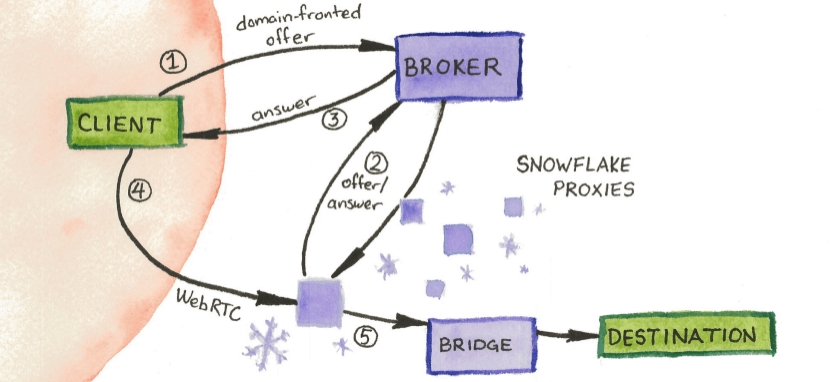
Snowflake is a tool designed to help people bypass Internet censorship. It works by connecting users in heavily censored regions to the open Internet through volunteers who run Snowflake on their devices—either as a browser extension or a standalone proxy. If you’re in a country where Tor is accessible, you can run Snowflake and act as a bridge for those who can’t access the Internet freely.
I’ve been trying to publish this post for two days. That’s how severe the current Internet blackout and censorship is here, given the current situation with war. Tools like Snowflake are often the only way people like me can connect to the outside world and access uncensored information, or contact their loved ones.
The easiest way to help is by installing the Snowflake browser extension. Once it’s enabled, you’ll see a green icon when someone connects through your relay. It’s simple, safe, and takes less than 3 minutes to set up—but it can make a world of difference.
By donating a small portion of your bandwidth, you help others communicate with loved ones, access crucial information, and stay connected—especially during crises like the one currently in the Middle East.
Micah Lee has been working on recent controversies around TeleMessage. If you’re not familiar with the topic, here’s a small backstory:
Some time ago, Mike Waltz and several senior U.S. government officials were caught discussing military plans on the messaging app Signal, after someone mistakenly added Jeffrey Goldberg, editor-in-chief of The Atlantic, to the conversation. Later, Waltz was seen using TM SGNL—a clone of Signal developed by TeleMessage—that includes features like cloud message archiving.
Micah recently created a program called TeleMessage Explorer , designed to simplify the investigation of TeleMessage dataset (provided by him and available to journalists and researchers) and published it under GNU AGPL v3, a free (as in freedom) license. It made me think about the importance of software freedom to achieve security and privacy. And it certainly made me appreciate Micah’s program more, as it didn’t refuse me my digital rights.
The license ensures users can run, study, modify, and share the program, as they wish. It ensures people own their copy of the program, rather than giving power to the developers to control what users can do.
I’ve been using generative transformers (so-called AI, such as ChatGPT) for some time now, and I’ve found them to be pretty useful. Whether I need a brief summary of an article or a quick one-sentence explanation of a blog post, they deliver it as I wish.
If I need a guide on setting up a secure system for managing my SSH keys, I can get a detailed step-by-step process. Or if I want help creating a cartoonish avatar for a friend’s daughter, that’s done in few seconds. They are doing an impressive job, and I genuinely appreciate the technology behind them.
However, I do have some concerns. Above all, I value my privacy. I don’t want any corporation creeping on my private conversations, nor do I want them tracking what and when I think about certain stuff. The size or structure of the corporation doesn’t matter to me—it’s my personal information, and I want control over it. That’s why I avoid sharing any sensitive data with these services. And if I do, I try my best to anonymize it.
The ChatGPT app from OpenAI states that when you delete a chat, it will be removed from their servers within a month. If they stick to this promise, they’re doing more than many other companies. Still, it doesn’t go far enough.
Real privacy and security are comes with free (as in freedom) software. Free software gives me the ability to modify and control the program, ensuring it works exactly how I want it to, not how a corporation dictates.
With free software, I have the power to take control of my computer. If the program compromises my personal data or violates my rights (online or offline) I can stop it. I’ll be the one in control.
Unfortunately, I haven’t yet found an so-called AI tool that is both free (as in freedom) and provides an openly accessible language model for public use. But I’m hopeful that this will change. As the free software community continues to grow (as it always has), I’m confident we’ll soon see generative transformers that respect freedom and privacy.
Apparently, Google is phasing out Manifest V2 in favor of Manifest v3 on its web browser, Chrome, and as a result, extensions using Manifest V2 stop working. Google is excusing this action by claiming the Manifest V3 enhances security and privacy of the users, which we know is false since Google’s tracking of users and violation of their privacy is what makes them money, and benefit is the only ting that drives them forward.
Chrome, and its parent project Chromium, are Google’s arms to impose its control and force on the web. They are what Google uses to force its “standards” on to web and control how users are able to browse it. Sadly, they have been successful so far, as Chrome (and Chromium-based browsers) are leading in usage share reports.
Extensions such as uBlock Origin are essential for people like me, who value their online privacy and are unable to tolerate the web today. I remember not having a tracker-blocker for an hour last year when I was setting up a new browser on a new computer I was going crazy.
Well, this doesn’t currently affect me as I never use Chromium-based browsers. Even ones such as Brave who advertise themselves as privacy-respecting are no good for me as I believe no matter how good they are, they eventually are empowering Google. I use Firefox-based browsers to, as little as my part is, fight back against monopoly-empowering web browsers.
You could switch to Firefox as well. It’s backed by nonprofit Mozilla Foundation and doesn’t miss a feature you’d get on other web browser. It’s also respectful to your freedom, published under a free (as in freedom) license .
I know Mozilla have not been acting so well recently but currently it’s the only choice we have Also, what we should do is not to boycott Mozilla, but forcing them to act in favor of the community, specially when it comes to choosing between what they offer and what Google has.
Web is already going to hell but it’s not too late. We still can take it back, and we should do whatever we can to take back control, for the sake of freedom, security, and privacy.
As technology is advancing every day, specially today, in the age of so-called artificial intelligence, privacy becomes more and more important. Today, everything we do and everywhere we go is recorded somewhere. There’s a track of our daily life somewhere in the hands of someone who is not supposed to know about it.
Sadly, technology is aiding this more and more and governments and powerful organizations depend on it to put control on our actions. Whatever we do, whatever we say, whatever opinion we have, every single detail of our lives are recorded. But happily, we’re not totally powerless.
Our freedom depends on our privacy. Privacy safeguards our fundamental rights. The ability to express our thoughts and feeling is crucial for our freedom. As a Middle Easterner, I get to gain a deeper understanding of this. Middle East is a special place. It’s where tyrannical governments do whatever they can to take away people’s freedoms and the way they do it is by taking away people’s privacy. More and more surveillance everyday and putting every single person under constant watch makes governments powerful enough to take control of what people can and can’t do.
Jamal Khashoggi was brutally murdered in Saudi embassy in Turkey in 2018, simply because his journalism and activism wasn’t in favor of the Saudi government. Saudi isn’t losing anything over this. Nobody actually cares about this anymore. They actually got to host the World Cup in 2034 . What it left as a precedent is that now more activist fear for their lives. If the government can assassinate a well-know journalist in its embassy in a foreign country, then they can make you disappear in a blink of an eye.
Privacy makes us bulletproof against these threats. I know it’s hard to disappear from the radar completely but there are steps to make it harder for the Big Brother . By using tools that enhance our privacy rights, we can effectively mitigate their attempts to impose surveillance on us.
I understand that it may be hard at our first steps but it worths the effort. We may not be able to pay cash for everything, or never carry our phones, or never give away any piece of personal information to someone, even if we try, mistakes will happen, but least is we gave it a try.
Ditching Gmail for a more privacy-focused alternatives, using web browsers and browser plugins that are designed to limit the data we share, using privacy-enhanced messengers and more importantly, encrypting whatever data we have is a start.
Doing so is not so hard. There are multiple good sources on the internet, and there are services and sites that guide people to start with taking their privacy more seriously. PrivacyGuides is one source I like.
We’re advancing. Every piece of technology we use today is somehow taking away our privacy and mining our personal information for the benefit of massive corporations and tyrannical spying governments. It’s so easy for them. Every piece of data we give these AI bots today are going to feed this surveillance machine, designed and launched to take away our freedom. There will be a day that none of us can speak freely because none of us will have enough privacy against regimes that rule us. This is of course preventable if we take serious steps towards more privacy.
We all have data we need to protect. It’s not about what kind of watch you wear, or what dog breed you think is the cutest, it’s about building a complete profile of you that will determine if you’re a threat to the ruling power. It’s not about what you post on Twitter today, it’s about what you’re going to shout in a protest against people who oppress you.
Let’s take a step forward and guarantee our freedom, and a safer place for our children.
Simone’s post “Outside the Wall” is inspiring. I’ve done it some time ago and I still revisit my password manager from time to time to check if there’s anything left I can delete. I first started this when I decided to limit my presence on social networks and service sites.
We should start such trend. Let’s de-bloat our online/digital life and post about it on our indie personal blogs to inspire others. We don’t need all this online presence and we need to take back our control on our digital life and freedom.
Of course, if you really need to use one of the silo accounts, I understand but we are mostly becoming addicted and slaves to these giant services and networks. Let’s take back our rights, freedom, privacy, and life. We spend so much time maintaining our presence on these networks and it needs to stop.
About a week ago, on my day off from work, I was in a car with a friend and we were stuck in traffic when something interesting happened.
When we hit the traffic, my friend instantly took out his phone and opened Instagram to watch some videos. It was interesting because we weren’t even fully stopped when he pulled out his phone from his pocket and he did that while still driving.
I was worried about our safety at that time but what concerned me more later was that is social media, specially short and random material like those on Instagram, making us impatient? I was interested in that and tried to watch my friends more carefully. Most of them had YouTube and Instagram installed on their phones and I realized how much people are addicted to these materials.
And I tried to further my semi-investigation by trying to show them a longer video, about 20 minutes long, and surprisingly they got impatient about 8 minutes in. They also have problem watching movies, I realized. Can’t put away their phones without constantly checking their notifications, messaging people, or even checking short videos. WHILE WATCHING THE MOVIE!
This semi-experiment made me concerned because I like to watch these random short videos sometimes. Of course I don’t have Instagram or any other social network on my devices so I think I’m less affected but it still made me worried.
So now I try to watch less of these videos, read more books and articles, and watch movies without checking my phone. I try to avoid opening YouTube links, avoid random short meaningless material, and even write more to take my mind off things.
It’s really worrying how toxic these social networks can be. Aside from the material we see on them, the impact they have on our brain is stressing.
I think the way Google+ worked was the nicest between social networks. Remember the circles? We would add every friend or person in a circle and we could choose what to share with each circle.
Sometimes some people were included in various circles and we could choose to share stuff with various people based on what information or material we wanted to share. That was nice. It was a replica of what we actually have in real life regarding our friendships.
I think social networks and microblogging services often try hard to give us a real-life experience and Google+ was the nearest we had ever.
But it was a social network after all and it was operating under Google so it was a nightmare regarding privacy and user rights, I still wouldn’t use it but the concept was very nice. If I had to use a social network, and there was a Google+-ish option, I would definitely choose it.