
Curiously, the failures of Communism are more often treated as a joke than as a tragedy. (As in the current jollity: What would happen if the Communists occupied the Sahara? Answer: Nothing—for 50 years. Then there would be a shortage of sand.)
William F. Buckley Jr.
Society
Posts about society, people, manners, communities, or whatever that concerns humans and humanity.
In the weights
There’s a site called IN THE WEIGHTS that I came across through Kev Quirk’s blog post . It checks whether you’re someone who lives on inside certain LLMs.
Large language models encode their knowledge and reasoning through billions of numbers called “the weights.” The amazing capabilities of AI come through adjusting those weights to better represent world knowledge and tasks.
“In the weights” means that a model is able to recall someone without using tools like web search.
intheweights.com
The site also says this matters because, and I quote, “being in the weights means your existence was deemed important in the process of creating superhuman artificial intelligence.”
So I had to try it.
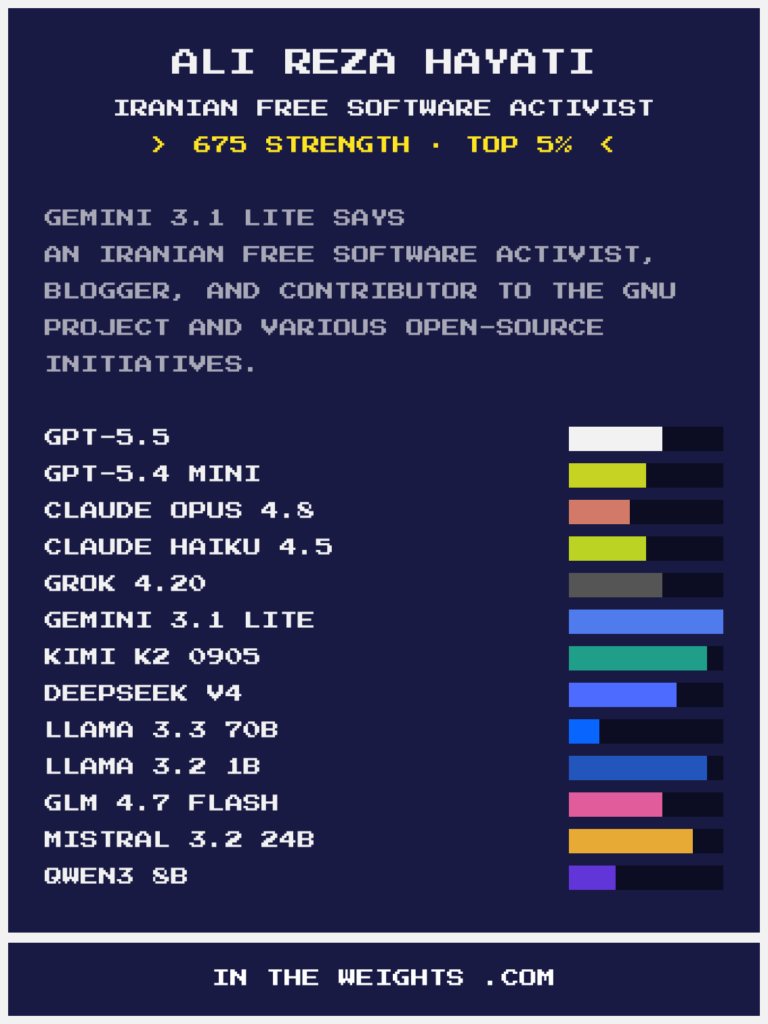
When I first typed in my name, it pulled up a bunch of different people, all with the same name as I have a common Persian name and surname. So I added phrases such as “Free Software” or “Blogger” to narrow it down and check if I actually live on in these LLMs. Turns out, I do.
Worth mentioning, the site itself doesn’t claim to be perfect. It openly admits that models can hallucinate details, mix up common names, and lose accuracy over typos.
Still, it’s worrying. These LLMs, these so-called AI agents, can identify you, learn about you, and quietly keep track of you, and there’s not much you can do about it. What worries me most is how cheap surveillance has become.
Countries used to pour huge amounts of money and resources into spying on people, keeping tyranny running, and forcing citizens into an unjust order people never agreed to. Now, all of that is becoming far too easy.
A handful of cameras across a city, wired up to a computer, and suddenly you know everything about everyone.
It’s a nightmare, honestly. Privacy, and the freedom to stay anonymous whenever you choose, are essential to real freedom and liberty. It’s a basic right, one that lets you raise your voice and speak your mind without the state shutting you down or silencing you.
Now these LLMs are being used to study you: every pattern you follow, everything you say, and everything you do. More than just learning about you, they’re designed to learn you, built and trained to track everything everyone does and says until they understand you inside out.
This same ability could keep people safe from terrorists, warn people of disasters, or help humanity become more creative, more productive, and more free. But it could just as easily be used to keep everyone in line, silenced, and scared.
It could go either way, and I really hope it heads in the right direction, towards a better future. Not one where a new kind of slavery is created, far worse than anything we’ve seen in the movies.
Danger of uninformed opinions
Have you ever seen a video of people talking or expressing opinions and you think to yourself “what kind of idiocy is this?” How dumb can you be to say such meaningless things? Certainly not dumber than you look.
You must forgive my language, as I’m writing this with complete disgust toward some people online. I can’t name them, and I can’t repeat what they said but have you ever experienced this? The feeling and the pressure inside to go and write about some random person, or sometimes rather famous people, and just express your utter disgust and aversion towards them?
And the worst part? People listen. They actually sit there, nod, and take it as gospel. Because the person saying it has a checkmark or a million followers on social networks, suddenly their word carries weight. It doesn’t matter if what they’re saying is completely detached from reality. The damage is already done the second it leaves their mouth.
I used to just ignore these, well because most of the time what they said didn’t affect me, but I learned that if you don’t rise to defend others, they won’t rise to defend you. It’s selfish but it’s, yet again, human.
But here’s the thing about ignoring it. Silence has a cost. Every time someone with a massive audience says something ignorant and nobody pushes back, that opinion starts to feel like a fact. It spreads. It gets shared, clipped, quoted, and before you know it, you’re arguing with someone at dinner who heard it from someone who heard it from that idiot online. That’s the damage I’m talking about. It’s not abstract, it’s very real.
I used to ignore them, but nowadays it bothers me a lot more than before. The fact that they have a platform to spread their idiocy, affect people, and seem reasonable, while being a complete idiot and ignoring the facts of the matter, is triggering me a lot lately. I’m so sick of this “I’m a celebrity so I have an opinion about everything” nonsense. You need education, you need facts, and you need actual information on the matter so you don’t spread your ignorance.
People underestimate how much this actually affects younger audiences especially. When a kid or a teenager sees someone they look up to confidently saying something wrong, something harmful, they don’t fact-check it. Why would they? That’s their idol. And that’s exactly where the real damage happens. Quietly, in the background, shaping how an entire generation thinks about something they never got the real story on.
You haven’t experienced it, you don’t know all the fact. I can believe your intentions are good but I won’t ignore the result of your idiocy. Your intentions are good, your outcome is the worst possible, sadly.
You can put back a movement, you can destroy years of hard work of people, and you can benefit the wrong people and damage a whole lot of people simply because you didn’t check what you’re spreading. It’s wrong. Please consult someone with the experience, someone with enough knowledge that will guide you to see the truth, or at least all sides of the matter.
Sadness
It’s strange how people know something is pointless, yet they keep doing it anyway. Feeling sad is one of them. Sadness does nothing except for draining our energy. Worse than that, it actively makes our problems feel bigger than they are.
Sadness is a snowball. Once it starts rolling downhill, it keeps growing. You don’t stop it. You feed it.
It usually begins with a single thought. Someone said something mean to me. Someone spoke badly about me. Something bad happened in my life. On its own, it’s small. But you keep thinking about it. You replay it. You add meaning to it. And it grows.
The more you think, the heavier life becomes. Everything feels harder. Meanwhile, the truth is simple and uncomfortable: the other person isn’t thinking about you at all. They don’t remember. They moved on. You didn’t.
At some point, this kind of thinking has to stop. It leads nowhere. If something can be changed and it’s within our control, then we should act. If it can’t, sitting in sadness is just self-harm with better branding.
Enough sadness. Complaining is not a plan. Thinking is not action. If we want change, we must do something. All of us have to. Starting right now.
Brain rot
I just witnessed something genuinely horrific. The worst case of brain rot I’ve ever seen.
I watched someone try to get through a two-minute video clip and completely fail. They couldn’t sit with it. They sped it up to 2x, skipped ahead a minute, jumped back to catch a “key part,” then hit 2x again. All over a video that barely lasts longer than a song.
It was rough to watch. Not being able to focus for two minutes says a lot about what endless scrolling and short-form videos are doing to people.
So I asked, half joking and half serious, “How do you watch a movie or read a book if you can’t even wait two minutes for this?”
The answer was simple: “I don’t.”
That was it. No explanation, nothing. Honestly, that’s what stuck with me the most. I feel bad for anyone who’s become like this. If you have reached this point, I’m truly upset for you. I hope you can reverse the effect.
Please use social networks
While politicians and ruling powers continue their efforts to restrict social networks and control the free flow of information, it is our responsibility to speak out, share the truth, and defend our right to freedom of speech and expression.
There are people, such as myself, who find social networks mentally overwhelming and choose to avoid them. They are not designed and built for everyone. Still, it doesn’t mean that social networks are inherently bad. Today, social networks are one of the most important platforms for free speech. People expressing their opinion, uncensored, is what makes democracy great.
As governments around the world tighten their grip on the cyberspace, it becomes harder to preserve our anonymity. We must fight to protect our rights. Absolute power always lead us to dictatorship. To safeguard our freedom, resistance is essential.
Using social networks is part of this resistance. The more people speak up, sharing stories of injustice and unfairness, and voicing their opinions without fear, the harder it becomes for any system to silence them.
Organizing rallies and protests isn’t simple. You have to bring together people who care about the same issue, keep things peaceful, respect the rights of others, set the right time and place, and make it big enough that the message actually gets heard. And even with guides on how to attend safely , many people worry about being recognized, which is often reason enough for them to stay away.
Social networks have made things easier. People everywhere can share their opinions and be heard without having to show up at a protest in person. But it’s still not completely safe. Many have faced punishment for what they’ve said online. House raids, lawsuits, and threats simply for speaking out against those in power. And while some believe using a fake name makes them anonymous, the reality is that there are plenty of ways to uncover someone’s true identity.
It’s worth reminding people that while protesting on social networks has value, it doesn’t replace showing up in person. Online speech is still speech, but politicians aren’t nearly as intimidated by posts as they are by physical marches and protests.
We should not take online protest for granted. If it were useless, those in power wouldn’t try so hard to censor it. It remains one of the strongest tools we have today. It spreads free information, gives people access to new knowledge, and helps communities stay informed about the issues that matter to them.
Even though I do not use social networks myself, I encourage others to take part in them. If it ever becomes necessary, I will use them too despite the problems I might face. Nothing is more important than our freedom, and if speaking out on these platforms helps protect it, then being active is not a choice but a duty.
This is especially clear in many Middle Eastern countries where less democratic regimes hold power. Authoritarian governments depend on keeping people uninformed, which makes social networks a direct threat to their survival. That is why they impose heavy censorship and work relentlessly to block the free flow of information in any way they can.
It hardly needs repeating that Jamal Khashoggi , a Saudi journalist, was assassinated inside the Saudi consulate in Turkey. In the MENA region, journalism that serves the people is often treated as a dangerous profession. Dictators understand the power of information, which is why they work so aggressively to control it.
That is why it is important to take back control of your online and digital life. Your presence in cyberspace matters, because every time you show up, you make it harder for those who want to silence you.
Using social networks is important, but what matters even more is staying in control of your data. Dictators are never afraid to use force, silence voices, or treat people unjustly, which is why owning your data is essential. Silo platforms such as Twitter (now X), and Meta (including Facebook, Instagram, etc.) harvest personal information and hand it over to third parties, including governments. That makes protecting your digital life just as critical as speaking out.
Safer social networks such as Mastodon (or more broadly the Fediverse) are better options. But it is still very important to choose your instance carefully, since the server you join shapes your experience and determines how your data is handled. They give you a voice, are designed to respect users freedom and privacy, and they’re free (as in freedom) software .
Freedom was never achieved easily, and the digital age is no exception. Whether through marches through the streets or voices raised online, every single act of resistance matters. Social networks can be powerful tools, but only if we use them wisely and remain in control of our data. The fight for freedom is the fight for our future, and it begins with each of us showing up, speaking out, and refusing to be silenced.
Taking advantage
I used to feel guilty about taking advantage of opportunities I have. In an unstable economy, such as one I live in, you try anything you possibly can to survive. Most of you probably have no idea how it’s like to sleep at night and wake up in the morning to see your money is now worth half.
In this kind of economy you try your best to invest wisely. You won’t keep cash, you buy gold. You won’t buy something that can lose value by using, you buy something that keeps it. Everything you have is an investment. Even your phone. A phone you buy for a thousand dollars will probably worth the same, if not more, one year from now.
We even invest for short terms, such as weeks. If I want to buy a laptop, I won’t keep cash, I’ll try to buy some gold so a month from now I won’t pay twice the cash I saved. That’s how it is to live in sanctioned and collapsing economies.
Gold is one of the most famous investments all around the world, but it’s even more popular here. Since it’s valuable everywhere in the world, so you’re no limited to local market, and it doesn’t rely on your state’s economy, it’s rising everywhere so if your economy collapses, you don’t lose everything.
Now when you invest in short terms, sometimes you feel guilty. If I buy ten grams of gold today so I can save for a new laptop, say for a month, and the price of that gold decreases in the month, so I actually lose a little, I’d probably be sad. But should I? Doesn’t that mean I’m actually sad because the economy is getting better?
Isn’t it wrong to feel happy when the price of gold increases (as a matter of local economy improving)? Well for people who experienced this for decades, no. I know the economy won’t improve in long term, because of the political situation, and the improvements we see are most-probably some trick to take away what I have.
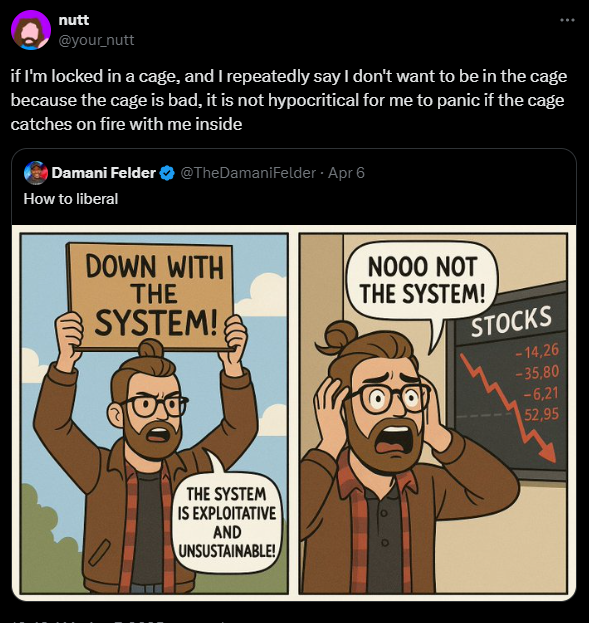
I used to feel guilty about feeling happy when some prices go up, because I had investments in that area, but no more. I’m in a cage and I don’t like it, nevertheless I won’t like it if the cage catches fire with me inside. Let me be free, and then do whatever you want with the cage.
Privacy has never been more important
As technology is advancing every day, specially today, in the age of so-called artificial intelligence, privacy becomes more and more important. Today, everything we do and everywhere we go is recorded somewhere. There’s a track of our daily life somewhere in the hands of someone who is not supposed to know about it.
Sadly, technology is aiding this more and more and governments and powerful organizations depend on it to put control on our actions. Whatever we do, whatever we say, whatever opinion we have, every single detail of our lives are recorded. But happily, we’re not totally powerless.
Our freedom depends on our privacy. Privacy safeguards our fundamental rights. The ability to express our thoughts and feeling is crucial for our freedom. As a Middle Easterner, I get to gain a deeper understanding of this. Middle East is a special place. It’s where tyrannical governments do whatever they can to take away people’s freedoms and the way they do it is by taking away people’s privacy. More and more surveillance everyday and putting every single person under constant watch makes governments powerful enough to take control of what people can and can’t do.
Jamal Khashoggi was brutally murdered in Saudi embassy in Turkey in 2018, simply because his journalism and activism wasn’t in favor of the Saudi government. Saudi isn’t losing anything over this. Nobody actually cares about this anymore. They actually got to host the World Cup in 2034 . What it left as a precedent is that now more activist fear for their lives. If the government can assassinate a well-know journalist in its embassy in a foreign country, then they can make you disappear in a blink of an eye.
Privacy makes us bulletproof against these threats. I know it’s hard to disappear from the radar completely but there are steps to make it harder for the Big Brother . By using tools that enhance our privacy rights, we can effectively mitigate their attempts to impose surveillance on us.
I understand that it may be hard at our first steps but it worths the effort. We may not be able to pay cash for everything, or never carry our phones, or never give away any piece of personal information to someone, even if we try, mistakes will happen, but least is we gave it a try.
Ditching Gmail for a more privacy-focused alternatives, using web browsers and browser plugins that are designed to limit the data we share, using privacy-enhanced messengers and more importantly, encrypting whatever data we have is a start.
Doing so is not so hard. There are multiple good sources on the internet, and there are services and sites that guide people to start with taking their privacy more seriously. PrivacyGuides is one source I like.
We’re advancing. Every piece of technology we use today is somehow taking away our privacy and mining our personal information for the benefit of massive corporations and tyrannical spying governments. It’s so easy for them. Every piece of data we give these AI bots today are going to feed this surveillance machine, designed and launched to take away our freedom. There will be a day that none of us can speak freely because none of us will have enough privacy against regimes that rule us. This is of course preventable if we take serious steps towards more privacy.
We all have data we need to protect. It’s not about what kind of watch you wear, or what dog breed you think is the cutest, it’s about building a complete profile of you that will determine if you’re a threat to the ruling power. It’s not about what you post on Twitter today, it’s about what you’re going to shout in a protest against people who oppress you.
Let’s take a step forward and guarantee our freedom, and a safer place for our children.