The three laws of personal devices

Law 1

Your devices must work in your interests and your interests alone.

Law 2

When a feature can be built so that algorithms and data are kept exclusively on the person’s own device, it must be built that way.

If a feature cannot be built in this manner, all data must be end-to-end encrypted and the owner of the device must be the exclusive holder of the private key.

Law 3

The hardware, software, and services must be free as in freedom .


This writing is modified and posted under Creative Commons Attribution-NonCommercial-ShareAlike 4.0 International (CC BY-NC-SA 4.0) license, originally written by Aral Balkan .

EdTech malware

Tech corporations are taking over the field of education by pushing their proprietary products into educational institutions of all levels. Proprietary applications loaded with malicious functionalities such as surveillance and collection of sensitive personal data—among many others—are being imposed on schools’ staff, teachers, students, and even parents. With the rapid expansion of online teaching, these proprietary educational technologies not only spread dramatically across schools, but they went from the classroom to the home.

This is not to say that educational technology is a bad approach per se. The problem arises when the software used in EdTech is nonfree, meaning it denies students the rights that free software grants all users.

Nonfree EdTech fails to assist the learning process by forbidding students to study the programs they are required to use, thus opposing the very nature and purpose of education . It does not allow school administrators and teachers to safeguard students’ rights by forbidding them to inspect the source code of the programs they run. It does not enable parents to make sure their children are protected from surveillance, data collection, and other mistreatment by the owner of the proprietary program.

Proprietary video conferencing software, as well as other nonfree programs, are tethered to online dis-services that collect large amounts of personal data. The school may have to agree to the company’s unjust terms of dis-service. The school, in turn, will typically force students to create an account on the dis-service, which includes agreeing to the terms.

EdTech companies are already developing great power over the students in the schools where they operate, and it will get worse. They use their surveillance power to manipulate students by customizing learning materials in the same way they customize ads and pieces of news. This way, they direct students into tracks towards various levels of knowledge, power and prestige.

These companies also structure their terms and conditions so that they are never held responsible for the consequences.

This article argues that these companies should get licenses to operate. That wouldn’t hurt, but it doesn’t address the root of the problem. All data acquired in a school about any student, teacher, or employee, must not leave the school’s control: whatever computers store the data must belong to the school and run free software. That way the school district and/or parents can control what it does with those data.

Join us in the fight against the use of nonfree software in schools.


This writing is copyrighted to GNU Education Team and GNU.org web site, licensed under CC BY-SA .

Copying is not theft

Many publishers often refer to copying they don’t approve of as “piracy.” In this way, they imply that it is ethically equivalent to attacking ships on the high seas, kidnapping and murdering the people on them. Based on such propaganda, they have procured laws in most of the world to forbid copying in most (or sometimes all) circumstances. (They are still pressuring to make these prohibitions more complete.)

The supporters of a too-strict, repressive form of copyright often use words like “stolen” and “theft” to refer to copyright infringement. This is spin, but they would like you to take it for objective truth.

Unauthorized copying is forbidden by copyright law in many circumstances (not all!), but being forbidden doesn’t make it wrong. In general, laws don’t define right and wrong. Laws, at their best, attempt to implement justice. If the laws (the implementation) don’t fit our ideas of right and wrong (the spec), the laws are what should change.

People should have right to copy and share what they own. When you purchase something you should be able to do whatever you want with it and that means you should be able to copy it, share it, keep it secret, use it as you wish, burn or destroy it, or even throw it away without using it. If it’s yours, it should work as you wish, not as someone else says.

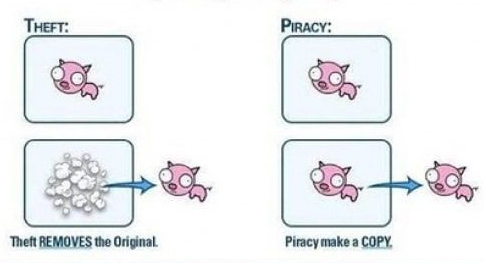
Many refer to copying as piracy or theft to manipulate you so you think you’re doing something ethically wrong but copying is not theft. In theft, you take something from somewhere or someone but with copying you’re just creating a new piece of that thing.

Imagine your car gets stolen but it’s still there!

If you don’t believe that copying not approved by the publisher is just like kidnapping and murder, you might prefer not to use the word “piracy” to describe it. Neutral terms such as “unauthorized copying” (or “prohibited copying” for the situation where it is illegal) are available for use instead. Some of us might even prefer to use a positive term such as “sharing information with your neighbor.”

A US judge, presiding over a trial for copyright infringement, recognized that “piracy” and “theft” are smear-words.


Part of this post is taken from GNU.org web site .

What is RSS (Really Simple Syndication)?

I always encourage people to use RSS or Atom feeds to subscribe to people’s blogs but many people need an introduction and explanation about RSS and Atom.

Let’s talk about RSS, as it’s not much different with Atom. RSS is basically a web feed that is readable by computers. A web feed is a data format used for providing users with frequently updated content. It means that whenever the blog or news feed gets updated, the user can receive the update in user’s feed aggregator.

Writers or so-called content distributors syndicate a web feed, thereby allowing users to subscribe a channel to it by adding the feed address to a feed aggregator client (also called a feed reader or a news reader).

The information could be blog entries, news headlines, or audio or video files. RSS documents usually contain complete or summarized text, metadata, and author and publishing information.

There are some distinct advantages to using RSS. Instead of visiting the individual websites, RSS feeds can help provide users with updates and information from different sites in one convenient place. For example, instead of visiting 30 websites every day, I just open my feed aggregator and hit the update button, and I get the latest published writings or media from those blogs or news sites I’m subscribed to.

With RSS, subscribing doesn’t need email! You won’t be asked to give away your email address to any blog or site, and that site won’t be able to sell your data to anyone. RSS just simply visits or opens the blog’s RSS file and checks for new writings or media, and will show it to you in a human-readable way.

Just like how you read this blog post on your web browser, but RSS gives you ability to read everything on your own computer without being forced to open my blog.

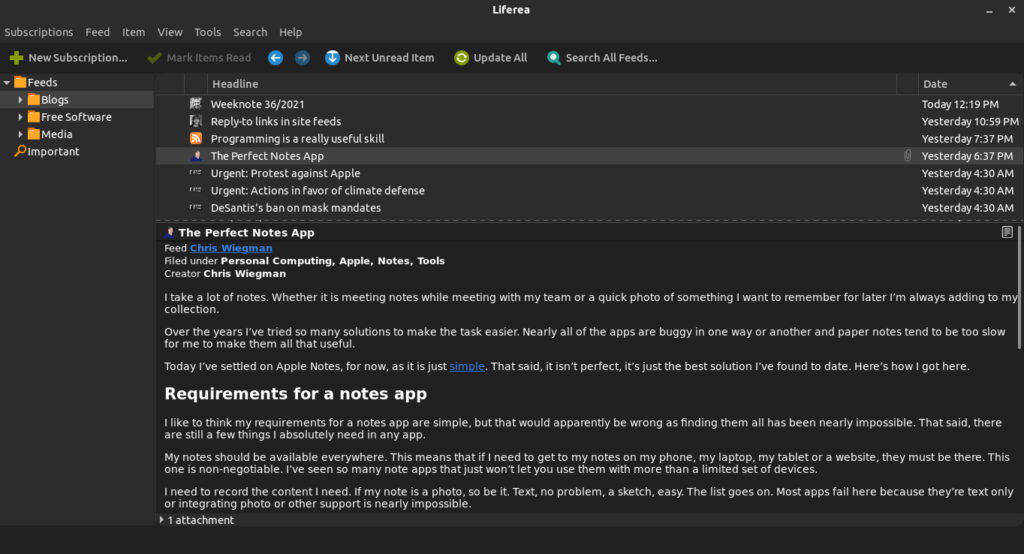
Sample of a feed aggregator program (Liferea), featuring Chris Wiegman ‘s blog post.

So what is Atom?

“The Atom Syndication Format is an XML language used for web feeds, while the Atom Publishing Protocol (AtomPub or APP) is a simple HTTP-based protocol for creating and updating web resources.” That was Wikipedia. In human terms, Atom is basically RSS with extra steps.

I personally prefer Atom feeds over RSS ones because Atom benefits from on-going innovation and is a standard. The Atom Syndication Format was published as an IETF proposed standard in RFC 4287 in December 2005, and the Atom Publishing Protocol was published as RFC 5023 two years later, in October 2007.

While the RSS vocabulary has a mechanism to indicate a human language for the feed, there is no way to specify a language for individual items or text elements. Atom, on the other hand, uses the standard xml:lang attribute to make it possible to specify a language context for every piece of human-readable content in the feed.

Also, the Atom working group chose to use timestamps formatted according to the rules specified by RFC 3339 (which is a subset of ISO 8601, my favorite time format).

How to use it really?

Subscribing to blog feeds may be the easiest thing you can do with your computer. First thing you need is a feed aggregator program. I use Liferea , which is a free (libre) program. There are a lot of other programs you can install. Thunderbird and Evolution email clients come with a built-in feed aggregator. If you use Nextcloud, the Nextcloud News app is super cool. Another suggestion is Akregator which is developed by KDE.

Second, you need to go to blogs or news sites you like and grab their RSS or Atom feed URLs. They usually provide their URLs somewhere in their site, possibly using the “subscribe” or similar phrases. An easy way to detect feed URLs is using web browser add-ons. I use Feed Indicator add-on on my Firefox-based browser. You can search similar terms to find more add-ons.

Third, you should copy the link of the RSS or Atom feed and paste it in your feed aggregator program new subscription form, and hit subscribe or OK or whatever it is. You’ll find out.

That’s it. You can now ask your program to update the feeds to get latest published writings or media on your favorite blogs or sites.

Apple is going to put a back door in your private life and the answer to that is free software

Apple’s new controversial anti-feature, named “protections for children,” opens a back door in your iPhone. The anti-feature is controversial not because it protects children, which is very needed and good practice, but because it chooses a wrong way to do so.

Apple has explained its privacy and security practices in its proposed back door but at the end of the day it’s a back door, and there’s no such thing as “only-good-guys back-door”.

Many people are angry about it and many are already campaigning to ask Apple reversing its decisions. A very known one, Apple Privacy Letter , is a campaign supported by EFF, Privacy Foundation, Freedom of the Press Foundation, and many others. They are asking people to sign the petition on GitHub and say “Apple’s proposal introduces a backdoor that threatens to undermine fundamental privacy protections for all users of Apple products.”

I don’t use Apple products. They’re proprietary and against computer user freedom. Instead, currently, I use a distribution of Android operating system named LineageOS. I’m not going to sign any campaign or beg Apple to respect my privacy. They violate people’s privacy in many ways, not only in this new back door.

When it comes to privacy, Apple is not a hero. It wasn’t long ago that Apple turned over iCloud data to Chinese government . Apple was not a privacy hero then, and is not a privacy hero now. They are very good at marketing and selling products, but they’re not, at all, a good actor in digital rights.

I agree, Apple’s privacy practices are much better than proprietary Android manufacturers, but that’s not enough. Respecting people is not giving them some privacy. As long as Apple is controlling everything and doesn’t give people full control over their devices, including software freedom and right to repair , they’re not a hero in anything but violating people’s rights and freedoms.

Many mobile operating systems and devices are not easy to use, I fully agree. GNU+Linux phones are not very suitable for daily use and Android devices may have some problems such as accessibility issues or bad user interfaces, but the real answer to this kind of controversies is not to beg Apple or anyone to respect us, but is to respect ourselves by running free software and privacy-respecting operating systems, and those are not made by Apple or any other proprietor.

You may say free software also has bugs and insecurities, free programs is not perfect. Yes, that is true. However, the difference between free and proprietary software in this respect is the handling of the bugs: free software users are able to study the program and/or fix the bugs they find, often in communities as they are able to share the program, while proprietary program users are forced to rely on the program’s developer for fixes.

If the developer does not care to fix the problem — often the case for embedded software and old releases — the users are sunk. But if the developer does send a corrected version, it may contain new malicious functionalities as well as bug fixes.

I urge you to answer to what Apple is going to do by installing and running a free operating system. Put yourself in control, and run software in which you can run freely, study, share, modify, and share your modifications. Free software empowers users and is the best answer for any situation, specially in ones like what we’re facing with Apple right now.

Fedora (Red Hat) removed a contributor because of his nationality

Ahmad Haghighi, a Fedora GNU+Linux contributor and ambassador was removed from the project because of his nationality. He mentioned this in a tweet announcing his contributions and posts in “Ask Fedora” are removed. Even the long first post of the Persian Ask Fedora is removed.

Matthew Miller, Fedora Project Leader and engineer at Red Hat said that “haghighi linked to a bio page he created on Fedora wiki which states that his location is in Iran. Once Fedora as a project becomes aware of that information, we have no option. Personally, I do not think this is a good policy. But it is not a Fedora policy or Red Hat policy — we need to do it to comply with the law, which the US government enforces seriously.”

I stopped using Fedora because of the same thing. The fact that Fedora complies with U.S. laws no matter if it imposes injustice on people is very disappointing for me. I know they are forced to do this but that doesn’t mean I can ignore this injustice.

Free software philosophy won’t allow any restriction on using the computer program, but doesn’t say anything about who can contribute on the main project. I believe the base of that is to restrict developers from doing injustices to people and since I believe the philosophy of free software is to avoid injustices, I believe this kind of act is against the soul of software freedom.

This action, whether from U.S. government or anyone else, is very hurtful not only to free software community but to all people and should be stopped. Whether it’s law or not doesn’t justify the action. I understand they’re forced to but don’t ask me to understand I’m considered an illegal being because of my location or nationality.

Privacy vs. “I have nothing to hide”

To start this article, I should mention what those words mean. Freedom means “the power or right to act, speak, or think as one wants without hindrance or restraint” and liberty means “the state of being free within society from oppressive restrictions imposed by authority on one’s way of life, behavior, or political views.” However, from now on, when I use any of those words, I mean both of them. So whether I write freedom or liberty, I mean “freedom and liberty”.

I value my liberty. I think liberty is what makes humans, humans. As a Middle Eastern, I understand how much my freedom is valuable and important. Us Middle Easterners are very much familiar with struggles one can have to gain freedom.

We fight for freedom in Middle East. If you’ve followed Middle East news in past 10 years, you surely understand what I’m talking about. Part of our fight for liberty needs us to be anonymous. In Middle East, you may get arrested or executed for simply talking against the dictator, so many of people take anonymity very serious when they talk politics, or anything else.

Anonymity is part of privacy. Anonymity is a choice when someone has privacy. I should explain this too. Being anonymous is a choice while privacy is a right. Someone with privacy can or may be anonymous but one can be identified and known while one still has privacy. I for example am active in a social network with my real name but I still take my privacy seriously, and am careful about my computing and acts.

Now back to what I was saying. In a situation like Middle East, privacy is so essential for living that almost everybody takes it seriously. I don’t mean all people are avoiding Google or Facebook, etc. but I mean they try their best to not give their data to the government.

People in Middle East basically understand the value and importance of privacy. However, even in Middle East, many people give me the argument of “I have nothing to hide” and refuse to take their privacy and rights seriously. Many don’t understand with not taking their privacy seriously, what they’re giving away.

To live as a free human being, and not be controlled or conquered by any person or power, you need privacy.

Arguing that you don’t care about the right to privacy because you have nothing to hide is no different than saying you don’t care about free speech because you have nothing to say.

Edward Snowden

Let’s start arguing against the “I have nothing to hide.”

Read more… “Privacy vs. “I have nothing to hide””

Stop accusing people of what they didn’t do

I sent this post as an email message to libreplanet-discuss mailing list.

Do you guys follow football? I mean the real football, not Amerikkkan one. There’s a club in Spain named Barcelona. They have a player in their team named Leo Messi. I think many of you know him.

Messi is believed to be one of the best football players in the history. During time, some people accused Messi of sexual assault and harassment. They even went to court for it and sued Messi. It turned out that all of them were only doing this for money, hoping that Leo Messi gives them some ransom.

There’s another player named Cristiano Ronaldo. Ronaldo is almost as same as Messi. He is again believed to be one of the bests in the history. He also was accused of sexual harassment and assault. Again, some people went to court and sued him, etc.

Some of the accusers never went to court but they tell very interesting stories on how they were assaulted. There were no proof and the teams (Barcelona and Real Madrid) never responded.

I can’t tell if those players who have a reputation of good behavior and charity and social work were really offenders or not, but I can tell one thing. Barca and Madrid didn’t let go of their best players because of some unproven accusations.

I remember Leo Messi once attacked a journalist physically because he was very angry but again, he made up to that, apologized, and never repeated such behavior because he was aware of how it can affect people. Again, we didn’t see any effort to ban Messi from playing football completely because that mistake.

I’m a football fan. I’m a fan of Manchester United, neither of those teams I mentioned but I never ever campaigned to throw out Messi and Ronaldo for unproven accusations.

I did not expect those teams to simply fire probably the best player of their history because some people said so.

Do you get my analogy here? I hear stories about an autistic person named RMS that he has assaulted women, harassed them, or sexually abused them. When I go and read the stories, I see what Stallman did was to “upset” some people. Not harassment, not assault, but upset.

Stallman shouted at some people or interrupted them while speaking. He hit on women or asked them out and insisted on that, which made them uncomfortable. If he was doing to me, I would be upset too, but I wouldn’t ever accuse him of assault or harassment. I wouldn’t expect FSF to fire its probably most valuable player that is known for his charity, effort for equality, justice, women’s rights, etc.

Why people expect FSF to fire its probably best player in history? I don’t understand that.

What people explain is not sexual harassment. He was an unpleasant person, maybe, to some people but he didn’t do anything to harass them.

Let me give you another example. There’s a different between patting some child on the butt and pedophilia. Now a pedophile most-probably does pat children on the butt but are all people who do that pedophiles? Hell no.

Please don’t accuse people of what they didn’t do because they made you uncomfortable or were unpleasant. If someone shouts at you, defend yourself or if the act of shouting makes you psychologically hurt, please be very very careful when you come out of your home because you may experience it almost every time.

If someone hitting on you makes you uncomfortable, ask them not to do that or ask security to help you but don’t accuse that person of harassment because looking at someone or being weird is not harassment. And again, please be careful when you come out of your house because you may experience it every day.

If someone interrupts you, ask them not to do that or argue back but don’t accuse that person of harassment because they didn’t harass you with that. Harassment is different. And please be careful when you come out of your house because people may interrupt you every day.

Stop with accusing people of things when they didn’t do that.

Also, please don’t accuse me of sexual harassment because I wrote this note. I don’t even know any of you and I did not harass you. Disagreeing with you is not harassment. Sending email messages is not assault.

I had to clarify that because as far as I’ve seen you people, the next open letter would’ve been for me. Don’t start arh-open-letter please. And yes, I’m mocking some people.